Friday, 2 March 2012

(My) puerh storage

Ageing sheng puerh is not that straight forward as I though. I remember when my first order of full cakes arrived and the scent of young shengs filled the room. The cakes were then stored on a shelf and the fragrance started to fade. Within a couple of months I had to stick my nose very close to smell anything. So, I started to search around the sites and found information about the types of storage and the importance of humidity and temperature. Based on what I read the humidity should be in the range between 60-90 % and the temperature from 20 to 30°C depending on the type of storage and quality of leaves. I prefer to not go into detail since my knowledge is quite limited, instead I would like to share the way I store my cakes. 

The first thing was a purchase of a simple device which measures the temperature and relative humidity. I found that the humidity in my room is around 50% during the summer and the first 2-3 months of the "central heating on" season. Then, at the end of the winter, the humidity slowly drop to 40-45%. This is simply not enough. 

To increase the humidity I used the classical approach of bowls with water in the cupboard. This helped to increase the humidity to 60 % but the temperature was still low, around 18-19%. So, I decided to improve this setup, and here are the ingredients: 

- An old unused bookcase
- One of the shelves is slightly modified (see the pictures below)
- 2-3 bigger plastic flower pots, in one of them an aquarium water heater

 Water containers with the heater (25W) adjusted to 25°C on the bottom shelf.

 I use tap water which is (unfortunately) heavily chlorinated what prevent the grow of microorganisms in the container. The upper shelf has holes for air circulation. 


The majority of cakes is placed on the upper shelf (in paper bags) but it can be also on the bottom one.


The front side is covered with a rug which let the tea "breath".

Half year ago when I started with this setup the humidity was around 70-75%. Now, when the air is quite dry in the room due to the months of heating, the humidity in the cupboard is between 65-70 % and the temperature 21-22°C. I think this may be ok for the cakes. Once per week the container with the heater has to be refilled (with cca 1L of water). The room is now filled with a healthy scent of young shengs, what is encouraging.

Ageing is tricky. If the humidity/temperature is too low the cakes will not age and they become flat. On the other hand too much moisture can cause a disaster called mold, therefore I try to avoid too humid conditions.  

How this setup works, will show the time.


Sunday, 26 February 2012

Home sweet home

Every time I go back home I feel so excited. Though Milano is not that far from Slovakia the journey to my home town is long and tiring. But it worth it! There are many things which makes these returns (or visits?) so special. First of all the people who I do care about the most: my fiancee and my parents, further the friends, the house in which I grew up and places connected with childhood memories. 

Most of my orders are delivered to Slovakia and there are two simple reasons why. The first is the fact that I store my puerhs back home, and the second reason is that I have bad experiences with the Italian post (I could write a whole page just about it). So, these short visits are connected with package openings, tasting and sample preparation.


As you can see, I am planning to dig into the production of big factories. Fortunately, the classical Menghai recipes are reasonably priced (though it is starting to change lately) so they don't make my valet much lighter and moreover the history showed that they are usually a good investment. 

Ps: Going back home is like a small Christmas for me :).

Thursday, 23 February 2012

2011 Superfine Long Jing

The days are getting hectic lately. I am trying to finish the experiments in the lab and meanwhile I am writing my thesis. Moreover, I have to think about what next and find a job these days is not easy. The evening tea drinking is a quiet moment in my day which helps me to relax and look at the thinks from different perspective. However, drinking young sheng or hongcha at the evening is not very beneficial for my sleep. I like these teas a lot but a session with 5-8g of tea can be a burden for the digestion and nervous system (due to the caffeine). I will switch to lighter teas for the evenings and leave the shengs for the weekend mornings, at least for a while. 

I bought a small package of this Long Jing from DTH during the last spring together with other Chinese greens. This one was clearly the best among them and I bought a bigger package later on, but since there was so many other teas to try I somehow forgot about it. Green tea has a shelf life so I kept it sealed in the fridge for the past half year or so.

Green-yellow flat buds, soft and fragile on the touch. 
5g/90ml gaivan
water temperature starting at cca 65°C and increasing with every steep.
20s, 10s, 30s, 45s, 1min, 2min, 5min.


The setup is simple but pleasing for eyes.

The dry leaves have candy-like sweet fragrance, some nutty and coconuts, mild but nice. After the first infusion the sweetness of the wet leaves is more pronounced, and I notice some higher notes and a bit of cooked green beans but without the heavy vegetal smell. 


On the early infusions the liquor is delicate and complex, I have to pay attention to pick up the complexity. On the later steeps a vegetable character with thicker consistency is added. The aftertaste appears right after the swallowing. Both the lid of the gaivan and the empty cup has a delicate sweet smell which is light and clearly different from the wild and heavy sweetness of young shengs.
For the last infusions boiling water was used which brought more intensity and some edges, but I like green teas at this stage (maybe even more than the initial smooth and complex infusions, maybe I am just not a delicate person :)
Good old tea bubbles.

I almost forgot how tricky is to brew green tea. There is a short region between the "underbrewing" and "overbrewing" and it takes a couple of trials to find the right parameters (and it can differ for every green) to get into this region. I usually use 3-4g of tea per 90ml of water but this time I used more to see how does it perform. The result was quite nice, the taste was clean without the heavy vegetal taste and other disturbing off tastes. However, the 3g setup works somehow better for me, giving crispier and more satisfying steeps. I think, this long jing will work well as a good night tea for the next few weeks.

Ps: The optimal solution would be to drink the strong teas like shengpu, hongcha or yancha at the mornings before going to work This would mean to wake up 2 hours earlier than usual, what would be very difficult for me :(. 

Sunday, 19 February 2012

Guests

It was two weeks ago when I posted about the cold in Milano. Then, suddenly within a few days, the temperature raised up to plus 10°C, the snow melted and it seems that the winter is gone. Apparently, I am not the only one who noticed that.


This grass found my balcony, at the 7th floor, to be a good place to grow. I think, I should stop to complain about "difficult conditions" :).

Thursday, 16 February 2012

2011 EoT - Bulang

I realised this week that I am out of young shengs. All my cakes are back home in Slovakia and plus some unopened packages are waiting in my room, while here in Milano the samples are gone. I have a full cake of the delicious 2011 Mansai with me but I can not drink it every day, I prefer diversity.

As I was searching for some sheng to drink I found the sample of 2011 EoT Bulang which I ordered last year. I remember the bloggers writing about this tea as strong, overpowering, violent, superpotent, and after my first session I could just agree with them. After 10 water-in-out infusions the bitterness was still covering most of the other characteristics. I left it to rest for 2 months or so and using less leaf the result was better. Almost one year has passed and the open package with the sample has been sitting in my room (also during the summer which is hot and humid here). It is time to take it out and see if it managed to settle down a bit.

4g/90ml gaiwan
10s rinse, 3s, 3s, 3s, 3s, 3s, 3s, 3s,10s, 20s, 30s, 45s, 1min, 2min
As I take out the opened bag and take a sniff, the smell of the dry leaves is intense even in the cold room. The wet leaves are on the lower side, nuttiness with tobacco. The  "3s" means water in and immediately water out steeps but even this seems to be too long :). The first 2-3 infusions are bitter as I expected, reminding me some herbal tea I used to drink for upset stomach. Even the aftertaste which suppose to be sweet is bitter. But than it starts to be more interesting, around the 3-4 infusion sweetness kicks in, the soup is thick-oily, and my throat and backs of the mouth is heavily coated, having some silky mouth feel(?).
The bitterness is still more than decent but turning to sweet aftertaste with some higher notes, it is really intense. The qi is particularly strong. After the second steep I already felt a "bang", I was just sitting sedated and watching out from my head, being sleepy. This changed after the next few infusions as the qi turned to an uplifting - energising feeling.  Six steeps was enough for me to be tea drunk so I interrupted the session for a few hours and continued at the afternoon.


Drinking this tea is a particular experience, but I am not sure if it is already enjoyable. It is not that kind of sheng which one could drink at the evening to relax, at least not now but after few years or a decade it will most probably change.

Anyways, I recommend to try or re-try this Bulang with less leaves and 2-3 rinses at the beginning. The EoT sells the full cake for 51 GBP what may seem to be a bit too much, and while it is not that suitable for immediate drinking, it is almost a safe bet for long term ageing. However it is out of stock now, what maybe isn't that bad because I would buy a cake in one of my weak moments :).

Sunday, 12 February 2012

Tea rings

During the last summer I attended a workshop in the beautiful city of Toledo (Spain). This city is famous about its craftsmanship like handmade steel weapons and pottery.

In one of the shops I found this hand painted cup (or jar?) and I took a pair as the volume is about 1.5 dcl what is fine for green tea.


It was siting on my shelf relatively unused since I don't drink to much green tea lately, so, it started to fulfil another function, as waste bowl. This may sound as a degradation but now, this little fellow, is  part of all my sessions and add some extra aesthetic feature. Usually the rinses stay in the bowl until the next tea drinking event and thus circles are forming on its wall.


Every ring is like a finger print or small memory of a tea.

Thursday, 9 February 2012

2011 EoT - Mansai


I discovered the shop of Essence of Tea relatively late. The quality of their own production of young shengs is particularly good and the prices are also ok. Since it is an European based shop I can avoid the high shipping fees and custom, and this is not a negligible criteria for me. 

With my first order also came a free sample of the 2011 Mansai. Among the 2010 production the 2010 Mansai was my favourite so I was curios if the 2011 will have similar qualities. The sample was enough for two sessions after which I had to admit that it is maybe even better than the one from 2010.

5g/ 90ml gaiwan
10s, 3s, 3s, 10s, 20s, 30s, 45s, 1min, 2min, 3min, long


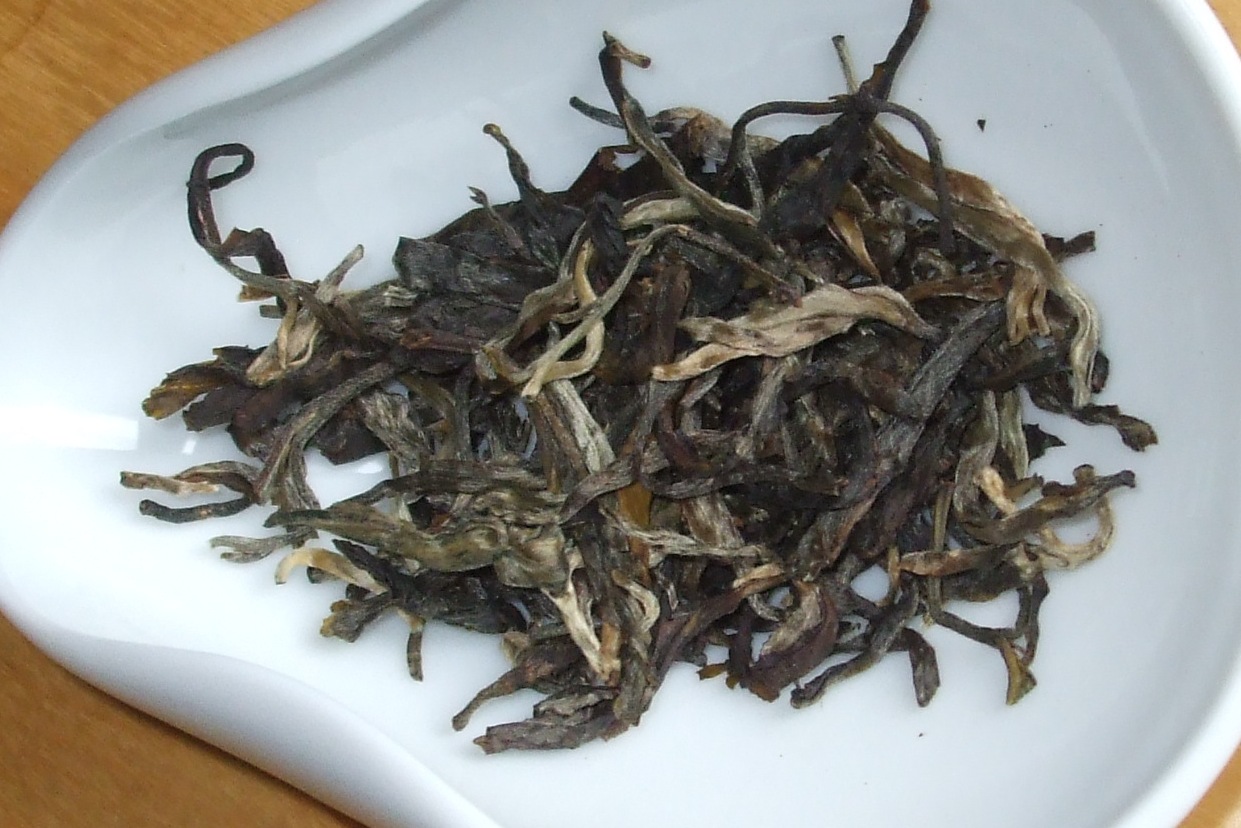
The dry leaves are pretty and offer a potent young sheng aroma from the hot gaiwan; combination of  mainly lower notes and some fruitiness. After the rinse the smell is strong and sweet inducing salivation.
The tea is loaded with sweetness and depth, the liquor is full and has a nice mouth coating effect.


There is some nice kuwei but no astringency. The huigan appears early and it is getting stronger with every infusion. A combination of fruity with broad tobacco base, highly enjoyable. Most of the young shengs become rough and astringent on the later infusion, but not this one, even the last long infusion delivers a sweet liquor still having the character of this sheng, what is a good sign for me. The qi is calming what I experience rarely with young shengs.

The leaves are nice: big and thick, it is a pleasure to look at them. 


Some of them are really magnificent.


I think there is no need to conclude that I like this sheng. The tea has young and wild character in a not offensive way. If you sample a couple of young shengs in a row, you will remember this one as impressive. Of course, I can not tell how it will age but it has the potency so I am optimistic. I bough a cake but after another few sessions (and the fact that there is no custom and the shipping fee is low) I took another one, so now I have one for drinking and one for ageing.


PS: It is only february but I am already waiting for the 2012 production of EoT shengs, it will be again an exciting period going through the new production.